Product focus
What it does
Guided form completion that keeps you as the final reviewer, with a hard line around what the AI is allowed to touch.
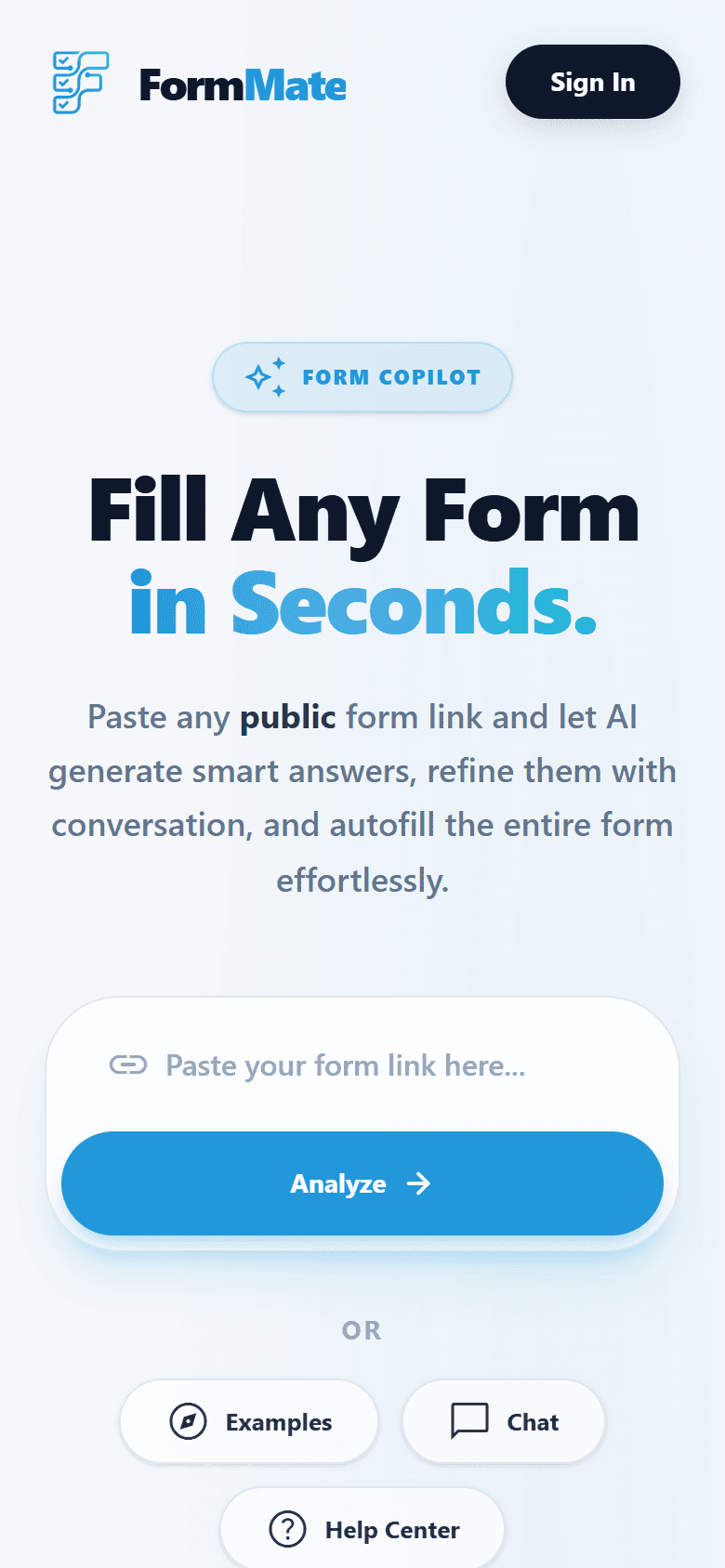
FormMate takes a form URL, listens to you talk through your details, and drafts every answer for you to review. The part I spent the most time on is the line between what it may write and what it must leave to you: every field is sorted into profile-filled, AI-drafted or manual-only, and passwords, ID numbers, file uploads and consent boxes are always manual. Nothing is submitted until you've looked at it. Parsing, drafting and transcription run through Groq's open models because speed was the deciding factor.
Product focus
Guided form completion that keeps you as the final reviewer, with a hard line around what the AI is allowed to touch.
Problem
Retyping the same details into every application form is dull enough that people abandon forms. The obvious fix is an AI that fills and submits for you, but the small models I could afford to run were erratic on exactly the fields where a wrong answer costs something. Reading the form is hard too: Google Forms need a sign-in even when the form is public, and interactive providers like Typeform and Jotform don't expose their full structure to a plain fetch.
Solution
Each field is classified into one of three fill policies. Profile fields (name, email, phone) come from your saved details, open-ended questions get an AI draft you can edit or regenerate, and anything sensitive or unsafe to guess is marked manual-only. The parser returns one result envelope with an explicit status instead of a quiet guess, and a provider guard downgrades weak extractions from Typeform, Jotform, SurveyMonkey, Qualtrics and Tally to partial and sends you to the screenshot-capture path; Workday is gated outright. Inference runs on Groq-hosted open models (Llama models for drafting, a vision model for screenshots, Whisper large-v3-turbo for speech) because open models are cheaper and tunable, and Groq is far faster than running them locally. Whisper runs server-side because local hardware was the bottleneck.
Developer notes
The version of this that worries me is the one that fills and submits without asking, so the interesting work was deciding where the AI stops. The small models I tried were too erratic to trust with a field a form actually cares about, so those fields stay manual and the model only drafts the open-ended ones. I chose Groq mainly for speed, since voice and form parsing feel broken when they lag. A lot of the repo is the unglamorous fixes that kept turning up: provider quirks, sign-in-gated forms, parse failures that had to be reported honestly instead of papered over. The commit history tells that story better than I can here.